November 13, 2025
If you follow the Karakoram Highway north from Hasan Abdal, the road begins to twist and climb. The plains flatten behind you, the air turns sharper, and soon the green valleys of Hazara Division open like a secret world. This is the land of the Hazarewaal — the people of the Hazara hills — who have called these mountains home for centuries.
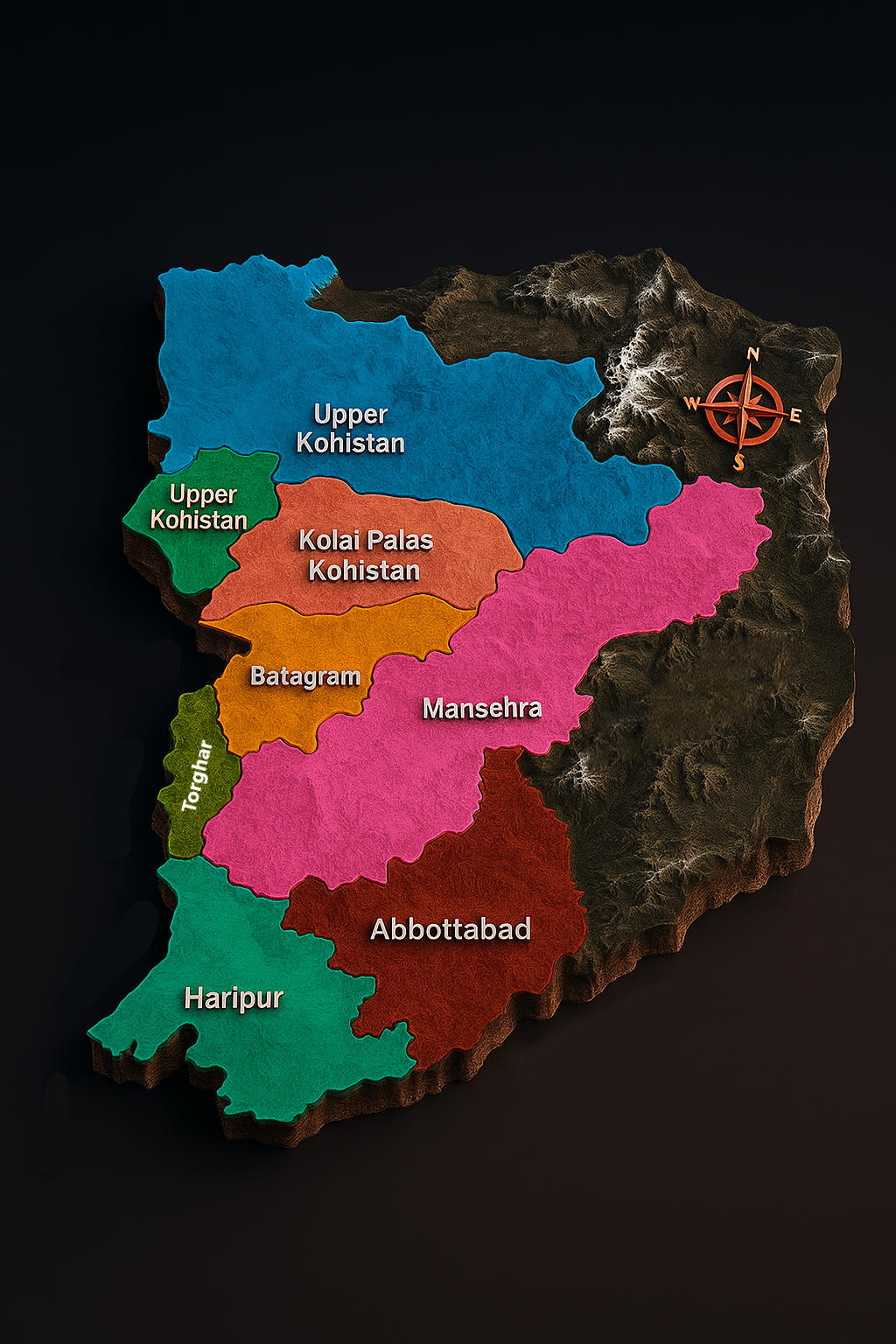
The term Hazarewaal doesn’t refer to a tribe or a single ethnic group. It simply means the people of Hazara. Their home, the Hazara Division of Khyber Pakhtunkhwa, lies in Pakistan’s northeast — bordered by Gilgit-Baltistan to the north, Azad Jammu and Kashmir to the east, Punjab to the south, and the rest of Khyber Pakhtunkhwa to the west.
Today, the division includes Abbottabad, Haripur, Mansehra, Battagram, Torghar, and the Kohistan districts (Abbasi, Kalhoro & Ayaz, 2022, p. 13). From the lush orchards of Haripur to the pine forests of Abbottabad and the rugged valleys of Kohistan, the region forms a natural bridge between Pakistan’s plains and mountains.
Hazara’s geography is destiny. It sits where three great landscapes meet — the Himalayas, the Karakoram, and the Hindu Kush. For centuries, this crossroads position drew migrants, traders, and rulers, giving the region its layered population and culture.
Early roots and historic crossroads
The Hazara region has seen countless civilizations pass through. Archaeological finds link it to the ancient Gandhara civilization, while later centuries brought waves of Turkic, Dardic, and Pashtun influence. When the Mughals ruled the subcontinent, Hazara was known as Pakhli Sarkar, part of the greater Kashmir province (Abbasi, Kalhoro & Ayaz, 2022, p. 14).
By the 19th century, Sikh and British administrators had divided the area into valleys and estates — Mansehra, Abbottabad, Haripur, and Tanawal — ruled by local chiefs but tied together under colonial governance. In 1901, the British created the North-West Frontier Province (NWFP), and Hazara became one of its settled districts (Abbasi, Kalhoro & Ayaz, 2022, p. 14).
That administrative act quietly united diverse communities, Awans, Tanolis, Swatis, Sayyeds, and Gujjars, under one regional name: the people of Hazara, or Hazarewaal.
A mosaic
To this day, Hazara’s population reflects that history of convergence. Most Hazarewaal families trace their roots to old tribes of northern India and eastern Afghanistan, yet over time their differences blurred into a shared regional identity. The majority speak Hindko, a soft Indo-Aryan language that stretches from Attock to Mansehra, though Pashto and Kohistani are also heard in the upper valleys.
The region’s main urban centers (Abbottabad, Haripur, and Mansehra) became melting pots where different castes and clans lived side by side, bound by trade, intermarriage, and a sense of belonging to the same mountain homeland.
The land between giants
Hazara has always stood between two dominant cultural spheres: the Pashto-speaking highlands to the west and the Punjabi plains to the south. This borderland position has defined the Hazarewaal experience, part frontier, part heartland.
As Anwar et al. (2021) observe, Hazara’s people “evolved a regional consciousness from their geography, a unity born not from tribe or blood, but from living between worlds” (p. 5). That consciousness is still visible today: in their pride for Abbottabad’s hills, in their shared stories of migration, and in the way they call themselves simply Hazarewaal: the people of this land.
A homeland
For outsiders, the word Hazara might sound like an administrative label. But for locals, it is emotional geography: a name that holds rivers, forests, and ancestral memory. To be Hazarewaal is to belong to Pakistan’s northern doorway, where mountain roads lead not just to Gilgit and Kashmir, but to centuries of history.
As one old saying goes, “Hazare te mushkil guzara.” Whoever has seen Hazara, carries it forever in their heart.
References
Abbasi, A. M., Kalhoro, J. A., & Ayaz. (2022). The Role of Hazaras in the Creation of Pakistan: The Post-Independence Search for Identity. Pakistan Journal of Social Research, 4(2), 12–17.
Anwar, M., Shah, N., & Bibi, R. (2021). Politics of Ethnic Identities and Conflicts: A Case Study of Hazara and Siraiki Ethno-Nationalist Movements in Pakistan. LASSIJ, 5(1), 1–15.
June 10, 2026
June 06, 2026
June 05, 2026